
TL;DR
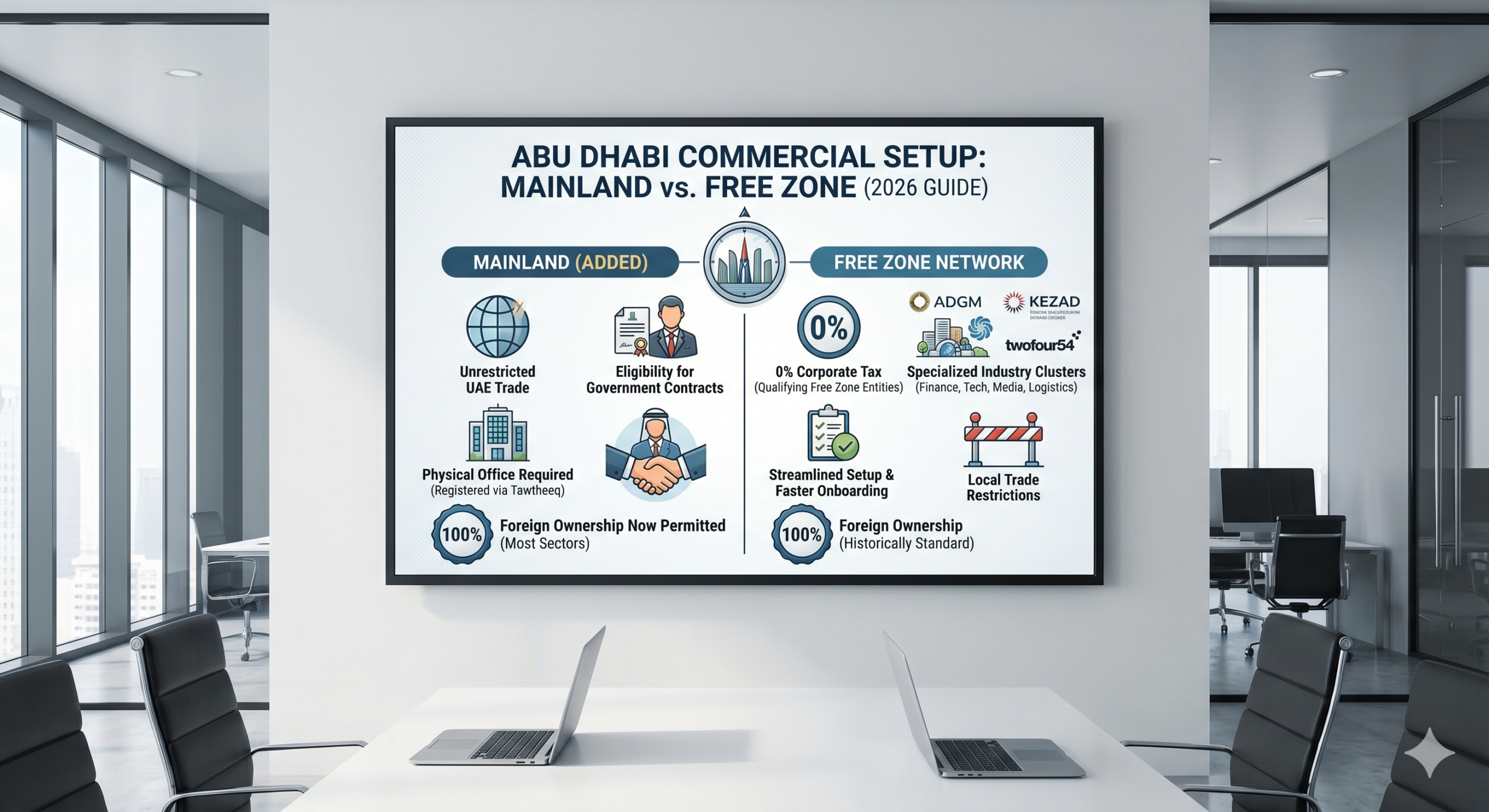
Mainland companies in Abu Dhabi offer unrestricted UAE market access and eligibility for government contracts, with 100% foreign ownership now permitted in most sectors. Free zones offer tax efficiencies, faster setup, and specialized ecosystems — but restrict direct trade within the UAE mainland. The right choice depends entirely on your target market, sector, and growth strategy.
What Is the Difference Between Mainland and Free Zone in Abu Dhabi?
Abu Dhabi’s commercial landscape is divided into two distinct legal and regulatory environments: the mainland, governed by the Abu Dhabi Department of Economic Development (ADDED), and a network of free zones, each operating as a semi-autonomous economic jurisdiction with its own authority, licensing framework, and benefits package.
For years, the mainland required foreign investors to hold a local Emirati partner with a 51% ownership stake. That changed significantly. Regulatory reforms now permit 100% foreign ownership across most mainland commercial sectors, fundamentally altering what was once the primary advantage of the free zone model.
Mainland Abu Dhabi: What You Need to Know
Who Is Mainland Best For?
The mainland is the default choice for businesses that need to operate freely across the UAE — selling directly to consumers, bidding on government tenders, or working without restrictions on where clients are based.
Key advantages of mainland setup:
| Feature | Mainland |
|---|---|
| Foreign ownership | Up to 100% in most sectors |
| UAE market access | Unrestricted |
| Government contracts | Eligible |
| Office location | Anywhere in Abu Dhabi |
| VAT registration | Required above AED 375,000 revenue |
| Regulatory body | ADDED (Abu Dhabi DED) |
What Does a Mainland Commercial Lease Look Like?
Mainland commercial tenants must register their lease through Tawtheeq, Abu Dhabi’s official tenancy registration system, before a trade licence can be issued or utilities activated through the Abu Dhabi Distribution Company (ADDC). All commercial leases are subject to 5% VAT, which landlords must charge and businesses may recover if they are VAT-registered for taxable supplies.
Free Zones in Abu Dhabi: The Full Picture
Abu Dhabi operates more than ten free zones, each designed around a specific industry cluster. Rather than offering a generic “low-tax” environment, Abu Dhabi’s free zones are purpose-built ecosystems.
Major Abu Dhabi Free Zones and Their Focus Areas:
| Free Zone | Primary Sector | Key Benefit |
|---|---|---|
| ADGM (Al Maryah Island) | Financial services, fintech | English Common Law jurisdiction |
| Masdar City | Clean tech, renewables | Estidama-compliant, sustainability ecosystem |
| KEZAD / KIZAD | Logistics, manufacturing, industrial | Deep-water port access, Etihad Rail connectivity |
| twofour54 | Media, entertainment, content | Content production licences, creative packages |
| ADAFZ | Aviation, cargo, freight | Direct access to Zayed International Airport |
| Hub71 | Technology startups | Funding access, equity-free government subsidies |
What Are the Key Benefits of a Free Zone?
- 0% corporate tax for qualifying entities (subject to Qualifying Free Zone Person criteria under UAE CT Law)
- 100% foreign ownership — historically the primary draw, now less differentiated from mainland
- Streamlined setup — most free zones offer single-window licensing and faster onboarding
- Sector-specific infrastructure — purpose-built offices, labs, production studios, warehouses
- Simplified import/export — customs benefits within the free zone perimeter
What Are the Limitations?
Free zone companies cannot trade directly with the UAE mainland without appointing a local distributor or setting up a separate mainland entity. If your business model requires serving UAE-based clients directly, this restriction significantly complicates operations.
Mainland vs. Free Zone: Side-by-Side Comparison
| Factor | Mainland | Free Zone |
|---|---|---|
| Foreign ownership | Up to 100% | 100% |
| Trade within UAE | Unrestricted | Requires distributor or branch |
| Government contracts | Yes | Generally no |
| Corporate tax | 9% (standard rate, exemptions apply) | 0% for qualifying entities |
| Setup speed | Moderate (ADDED + Tawtheeq) | Fast (single-window authority) |
| Office requirement | Physical office mandatory | Flexi-desk options available |
| Best for | Local market, government, professional services | Export-focused, sector-specific, international |
How Do I Decide Which Is Right for My Business?
Choose mainland if:
- Your clients are primarily UAE-based businesses or consumers
- You want to bid on Abu Dhabi or federal government contracts
- You need flexibility in where your office is located
- You are in professional services, retail, healthcare, or education
Choose a free zone if:
- You are export-focused or serve international clients
- You are in a sector with a dedicated free zone (finance, tech, media, logistics)
- You want to benefit from 0% corporate tax as a qualifying entity
- You need a fast setup with minimal bureaucracy
Frequently Asked Questions
Can a free zone company open a branch on the mainland? Yes. A free zone entity can establish a mainland branch through ADDED, though the branch will be subject to standard mainland licensing and regulatory requirements.
Is 100% foreign ownership available for all mainland sectors? Most commercial sectors now permit full foreign ownership. A small number of strategic sectors — including certain defence, security, and utilities activities — retain local ownership requirements. Your legal adviser should confirm eligibility for your specific licence activity.
What is the corporate tax rate in Abu Dhabi? The standard UAE corporate tax rate is 9% on taxable income above AED 375,000. Free zone entities meeting Qualifying Free Zone Person (QFZP) criteria may be eligible for a 0% rate on qualifying income.
Do I need a physical office on the mainland? Yes. ADDED requires a physical tenancy agreement registered via Tawtheeq. Virtual offices do not satisfy the licensing requirement for most activities.
How Tate Real Estate Can Help
Selecting the right jurisdiction is only the first decision. Finding the right commercial space — the correct size, grade, location, and lease structure — within that jurisdiction is where the real work begins. Tate Real Estate specialises in Abu Dhabi commercial property, from Grade A offices in ADGM to warehousing in KEZAD. Our team understands both the regulatory framework and the practical realities of the Abu Dhabi market.
Contact Tate Real Estate to discuss your commercial setup requirements.

