

TL;DR
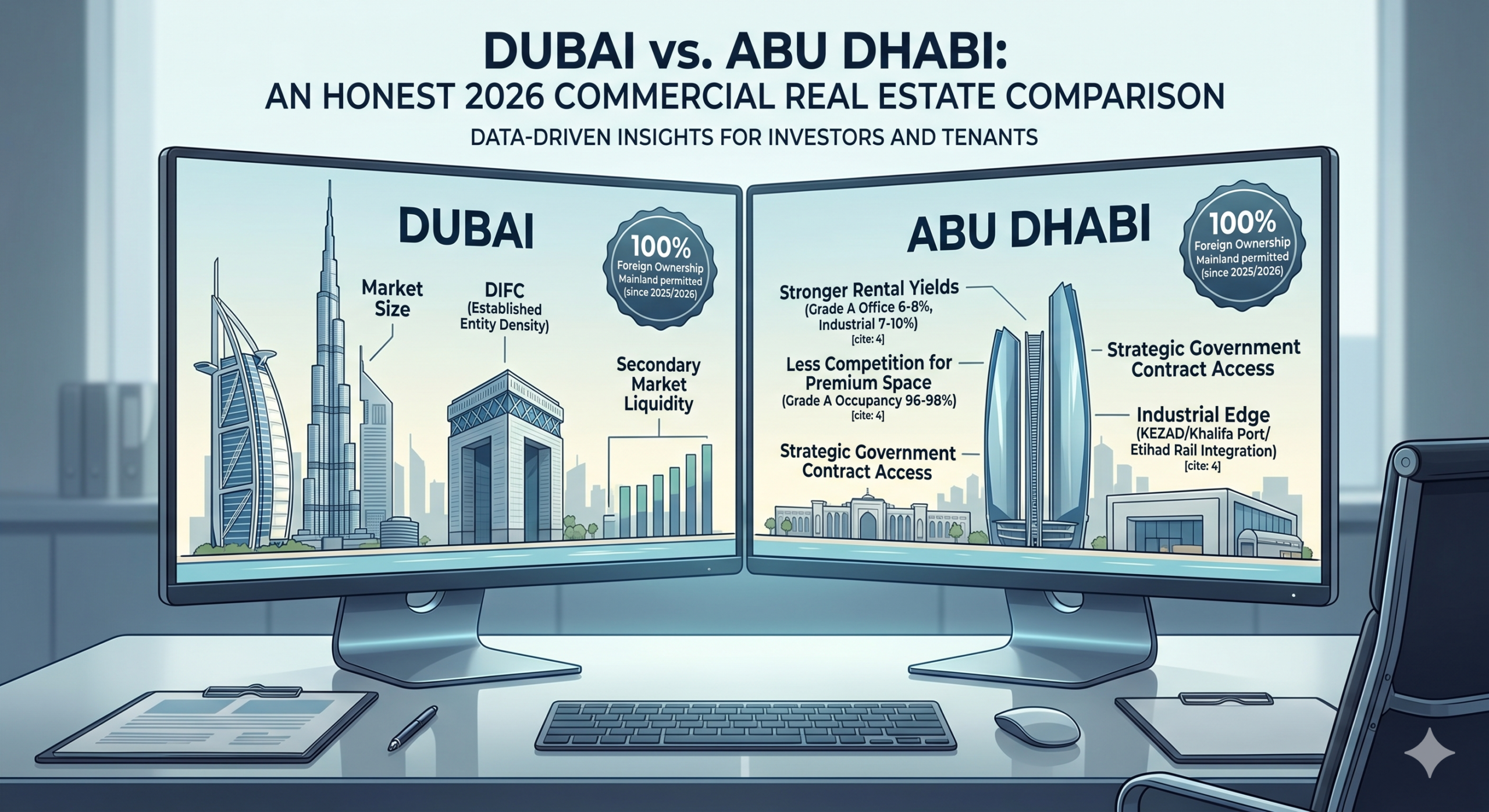
Dubai dominates brand recognition and attracts the highest volume of international commercial real estate activity. Abu Dhabi offers comparable — and in some segments superior — yields, significantly less competition for premium space, stronger government contract access, and a regulatory environment that has become materially more investor-friendly since 2025. Neither market is categorically superior; they serve different business profiles, investment strategies, and risk appetites.
Why This Comparison Matters
Every international investor, corporate tenant, or business considering commercial real estate in the UAE eventually faces the same question: Abu Dhabi or Dubai?
The instinctive answer is usually Dubai — and for many use cases, that instinct is correct. But for a substantial and growing segment of corporate and investor demand, Abu Dhabi is not just a credible alternative. It is the objectively stronger choice.
This guide provides a data-driven, bias-free comparison of both markets as they stand in 2026.
Market Size and Transaction Volume
Abu Dhabi’s real estate market recorded AED 142 billion in total transactions in 2025 — a 44% year-on-year increase. This is no longer a secondary market quietly sitting in Dubai’s shadow. The growth trajectory reflects both the success of Abu Dhabi’s economic diversification agenda and a fundamental rerating of the emirate’s investment appeal among international capital.
Dubai’s market remains larger in absolute transaction terms, benefiting from a larger population base, a more developed secondary market, and decades of international brand building. However, the gap is narrowing, and on specific metrics — particularly commercial rental yields and supply constraints — Abu Dhabi is highly competitive.
Office Market: Occupancy, Supply, and Rent
| Metric | Abu Dhabi | Dubai |
|---|---|---|
| Prime Grade A occupancy (2026) | 96–98% | 90–95% |
| Grade A rent range (AED/sqm/yr) | 1,800 – 2,500+ | 2,000 – 3,500+ |
| New Grade A supply pipeline | Limited | Moderate |
| Primary financial district | ADGM, Al Maryah Island | DIFC |
| Alternative districts | Capital Centre, Al Reem | DWTC, Business Bay, JLT |
Abu Dhabi’s Grade A office market is operating at near-full capacity. The supply constraint is structural — relatively few new Grade A completions are expected in the near term — which is sustaining landlord pricing power and making long-term lease security a premium consideration for tenants.
Dubai’s DIFC remains the Gulf’s most established financial centre by volume of registered entities, but Abu Dhabi’s ADGM is growing rapidly. ADGM now houses over 2,088 operational entities and operates under English Common Law — a critical differentiator for international financial services firms accustomed to common law jurisdictions.
Industrial and Logistics Real Estate
Abu Dhabi holds a structural advantage in the industrial and logistics segment that is not widely discussed outside the sector.
KEZAD (Khalifa Economic Zone Abu Dhabi) is directly integrated with Khalifa Port — one of the region’s most significant deep-water port facilities — and the Etihad Rail network, which will connect all seven emirates by 2030. Warehouse rents in KEZAD have risen by approximately 38% year-on-year as third-party logistics operators and e-commerce companies compete for space.
Mussafah, Abu Dhabi’s established heavy industrial zone, recorded rental growth of approximately 27% in the same period.
Dubai’s logistics market is anchored by Dubai South (adjacent to Al Maktoum Airport) and Jebel Ali Port. Both remain world-class facilities. However, KEZAD’s integration with Khalifa Port and its lower baseline land costs offer a compelling alternative for businesses in manufacturing, assembly, and bulk logistics.
| Metric | Abu Dhabi (KEZAD/Mussafah) | Dubai (Dubai South/Jebel Ali) |
|---|---|---|
| Port access | Khalifa Port (deep-water) | Jebel Ali Port (world’s largest man-made) |
| Rail connectivity | Etihad Rail (2026 passenger services) | In development |
| YoY warehouse rent growth | 27–38% | Comparable |
| Land availability | More available | More constrained |
Free Zones: A Tale of Two Ecosystems
Both emirates operate extensive free zone networks. The key differences lie in specialisation and legal framework.
Abu Dhabi’s standout free zones:
- ADGM — English Common Law, financial services, rated among the world’s top financial free zones
- Masdar City — Global clean tech hub, mandatory sustainability standards, net-zero built environment
- Hub71 — Tech startup ecosystem with equity-free government funding access
Dubai’s standout free zones:
- DIFC — The Gulf’s most established financial free zone, largest by entity count
- Dubai Internet City / Media City — Dominant in tech and media
- Dubai South — Aviation, logistics, and soon the world’s largest airport
For financial services firms choosing between ADGM and DIFC, the decision frequently comes down to which client base is more relevant and which legal system is more familiar. Both operate under English Common Law. DIFC has more operational entities; ADGM is growing faster on a percentage basis.
Rental Yields: Where Does the Investment Case Stand?
Commercial rental yields are a primary consideration for property investors, and Abu Dhabi consistently delivers strong numbers.
| Asset Class | Abu Dhabi Yield Range | Dubai Yield Range |
|---|---|---|
| Grade A office | 6–8% | 5–7% |
| Industrial/warehouse | 7–10% | 6–9% |
| Retail | 7–9% | 6–8% |
Abu Dhabi’s yields are generally 50–100 basis points higher than equivalent Dubai product, reflecting both higher rental growth momentum and a lower price base in absolute terms. For yield-focused investors, this differential is material over a 5–10 year hold period.
Regulatory Environment: 2025–2026 Reforms
Abu Dhabi’s 2025 real estate law reforms have significantly modernised the commercial property regulatory landscape:
- Madhmoun platform — Mandatory verified property listings, reducing fraud risk and improving market transparency
- Brokerage Licence Numbers (BLN) — Required for all real estate professionals, improving adviser accountability
- Tasweya Centre — New dedicated real estate dispute resolution body for faster commercial resolution
- 100% foreign ownership — Now available across most mainland commercial sectors
Dubai has a more mature regulatory framework with longer track record, but Abu Dhabi’s reforms are closing the governance gap rapidly.
Which Market Should You Choose?
| Choose Abu Dhabi if… | Choose Dubai if… |
|---|---|
| You need government contract access | You need the largest international business community |
| You are in logistics, industrial, or manufacturing | You are in financial services and want DIFC’s entity density |
| You want higher rental yields on commercial assets | You prioritise the deepest liquidity for asset sales |
| You are in clean tech, renewables, or sustainability | You are in hospitality, tourism, or consumer-facing retail |
| You want a less competitive, less crowded market | You want maximum brand visibility and talent pool access |
Frequently Asked Questions
Can I own property in both Abu Dhabi and Dubai? Yes. Foreign investors can own commercial and residential property in designated Investment Areas in both emirates. Each emirate maintains its own register and investment area designations.
Is it cheaper to set up a company in Abu Dhabi than Dubai? Setup costs are broadly comparable, though free zone package pricing varies significantly. Abu Dhabi free zones including Masdar City and twofour54 offer competitive entry-level packages. Dubai’s free zones span a very wide price range. The cost of commercial premises — a key variable — is generally lower in Abu Dhabi.
Which emirate has better transport infrastructure? Both are world-class. Abu Dhabi’s Etihad Rail integration and Khalifa Port expansion strengthen its logistics advantage. Dubai’s Al Maktoum Airport expansion, when complete, will make it one of the world’s highest-capacity air freight hubs.
How Tate Real Estate Can Help
Tate Real Estate specialises in Abu Dhabi commercial property — not because it’s the only market, but because it’s the one we know most deeply. If you’re assessing Abu Dhabi as part of a wider UAE commercial strategy, or if you’re ready to act on an Abu Dhabi opportunity specifically, our team provides independent, data-backed guidance across all commercial asset classes.
Contact Tate Real Estate to discuss your requirements.
