
TL;DR
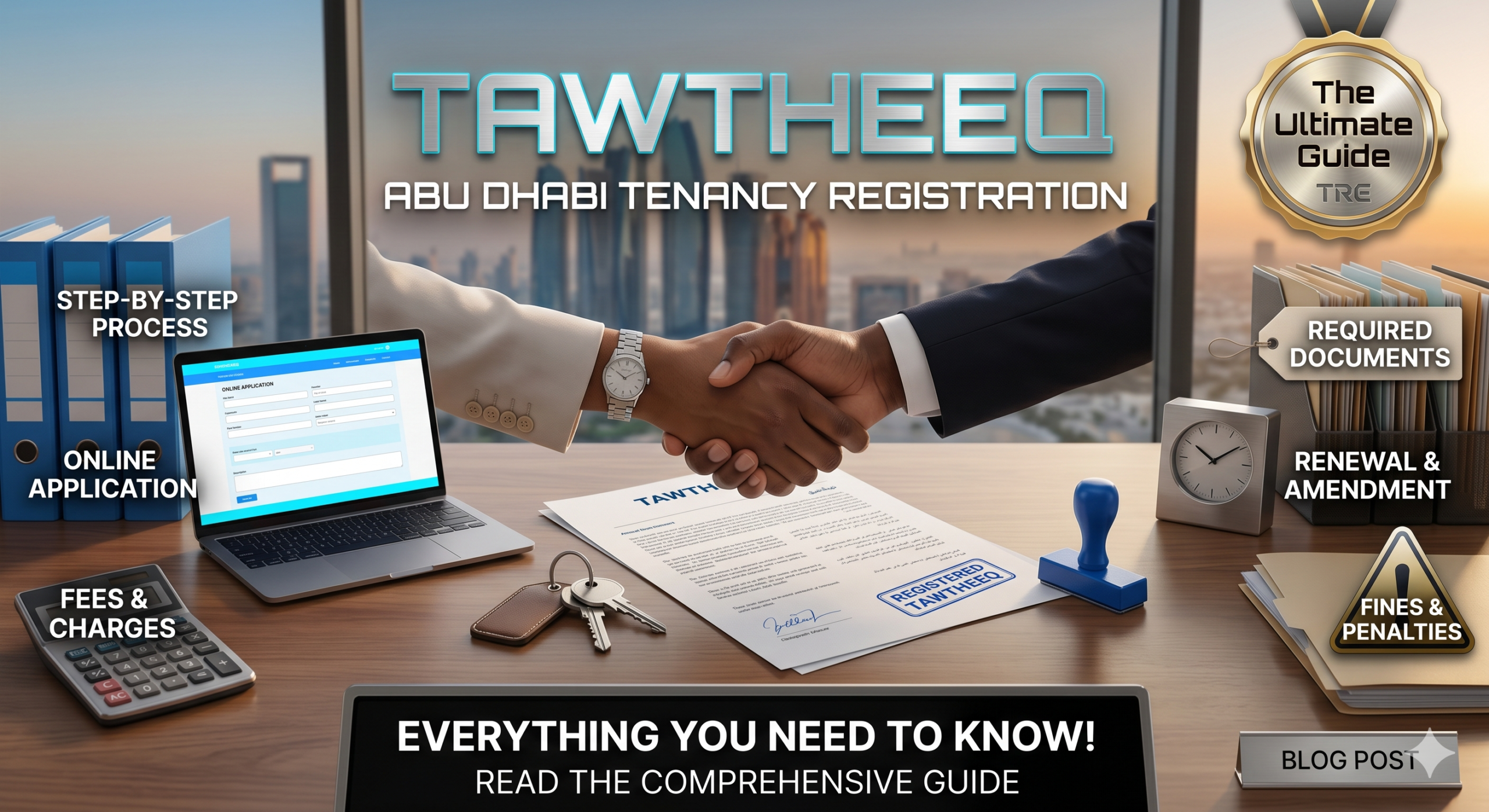
Tawtheeq is Abu Dhabi’s mandatory tenancy contract registration system, administered by the Abu Dhabi Department of Municipalities and Transport (DMT). Every tenancy — residential or commercial — must be registered through Tawtheeq before a trade licence can be issued, utilities can be activated, or legal protections can be enforced. Unregistered tenancies are not void, but they leave both landlord and tenant without formal legal standing in any dispute. This guide covers every stage of the Tawtheeq process: what it is, who needs it, how to register, what it costs, how renewals work, and what happens when things go wrong.
What Is Tawtheeq?
Tawtheeq — derived from the Arabic root meaning “to document” or “to verify” — is Abu Dhabi’s official tenancy contract attestation and registration system. Launched and administered by the Abu Dhabi Department of Municipalities and Transport (DMT), the platform creates a government-authenticated record of every tenancy agreement executed within the emirate of Abu Dhabi.
The system was introduced to achieve several overlapping objectives:
- Market transparency — Creating a verifiable, searchable database of all active tenancies, preventing landlords from renting the same unit to multiple parties or obscuring occupancy status
- Tenant protection — Ensuring tenants have government-recognised documentation to enforce lease rights and access dispute resolution
- Regulatory compliance — Linking tenancy registration directly to trade licensing and utility activation, making non-registration structurally impractical
- Rental market data — Providing DMT with accurate, real-time data on rental rates across Abu Dhabi, which informs the Rental Index used to govern permissible rent increases
Tawtheeq covers properties across Abu Dhabi Island, Al Ain, Al Dhafra, and all areas under Abu Dhabi Emirate jurisdiction. It applies to both residential and commercial tenancies, with different processes, fee structures, and implications for each.
Who Needs to Register Through Tawtheeq?
All Landlords
Any property owner leasing a property in Abu Dhabi — whether individual or corporate, UAE national or foreign investor — is required to register the tenancy agreement through Tawtheeq. There are no exemptions based on property type, lease duration, or nationality of the parties involved.
All Tenants (Residential and Commercial)
Both residential and commercial tenants are parties to the Tawtheeq registration. While the landlord typically initiates and completes the submission, tenants must provide their documentation and — critically — must ensure registration has been completed before attempting to activate utilities or apply for trade licences.
Property Management Companies
Where a property management company acts on behalf of a landlord, the management company can register the Tawtheeq contract using their own authorisation credentials, provided they hold a valid property management licence in Abu Dhabi and an authorisation document from the property owner.
Tawtheeq for Residential Tenancies
Why Residential Tenants Need Tawtheeq
For residential tenants, Tawtheeq registration unlocks access to a cascade of essential services and protections:
ADDC Utility Connection — The Abu Dhabi Distribution Company (ADDC) requires a Tawtheeq certificate before connecting electricity and water services to a residential unit. Without it, a tenant cannot power or water their home through the formal utility network.
Residency and Visa Sponsorship — Tenants sponsoring family members or domestic workers in Abu Dhabi must demonstrate a registered residential address. A Tawtheeq certificate is the recognised proof of a valid residential tenancy for this purpose.
Emirates ID Address Update — Updating your registered address on your Emirates ID through the Federal Authority for Identity, Citizenship, Customs and Ports Security (ICP) requires proof of a valid registered tenancy. Tawtheeq serves this purpose.
Legal Protection — If a dispute arises with your landlord — over rent increases, maintenance obligations, eviction, or deposit return — your registered Tawtheeq contract is the foundational document in any formal resolution process at the Tasweya Centre.
School and Healthcare Enrolment — Some government schools and healthcare facilities require proof of Abu Dhabi residency at a specific address. A registered Tawtheeq contract satisfies this requirement.
The Residential Registration Process: Step by Step
Step 1: Execute the Tenancy Agreement
Before any registration can occur, the landlord and tenant must sign a tenancy agreement. For residential properties, this agreement should specify:
- Property address, unit number, and building name
- Full names and identification details of both parties
- Lease start date and end date
- Annual rent amount
- Payment structure (number of cheques and due dates)
- Permitted occupants (some buildings restrict occupancy to specific family configurations)
- Maintenance obligations
- Security deposit amount and conditions for return
Step 2: Gather Documentation
Landlord documents required:
- Original title deed of the property
- Emirates ID (for individual landlords)
- Trade licence (for corporate landlords)
- Power of attorney (if a representative is registering on behalf of the owner)
Tenant documents required:
- Emirates ID (UAE residents)
- Passport copy (for non-UAE nationals)
- Visa copy (for expatriate residents)
Step 3: Access the TAMM Portal or ADM Application
Tawtheeq registration is completed through the TAMM platform (tamm.abudhabi) — Abu Dhabi’s integrated government services portal. The TAMM app is available on iOS and Android. Alternatively, registration can be completed in person at Abu Dhabi Municipality customer service centres.
Navigate to the Real Estate section within TAMM and select the Tawtheeq service.
Step 4: Submit the Application
Enter all tenancy details into the portal. Upload all required documents. Ensure the annual rent figure entered matches the signed tenancy agreement exactly — discrepancies will cause rejection.
Step 5: Pay the Registration Fee
Residential Tawtheeq registration fees are calculated based on the annual rent value of the property. Fees are subject to periodic review by DMT; confirm the current applicable rate at the time of registration through the TAMM portal or a licensed real estate broker.
Step 6: Receive the Tawtheeq Certificate
Upon approval — typically processed within 1–3 business days for complete, correctly submitted applications — both landlord and tenant receive a digitally authenticated Tawtheeq certificate. This is the document you will present to ADDC, ICP, and other authorities.
Residential Lease Renewals and Tawtheeq
A new Tawtheeq registration is required each time a residential lease is renewed or materially amended. If the annual rent increases, the contract term changes, or a new party is added, the Tawtheeq record must be updated.
Rental Increase Rules for Residential Properties
Abu Dhabi’s Rental Index — maintained by DMT — governs the maximum permissible rent increase at the time of renewal. Landlords are not permitted to increase rent by more than the Rental Index allows for the relevant property category and area. As a general principle, increases have been capped at 5% per renewal cycle, though the precise applicable rate depends on the property type and prevailing index values at the time of renewal.
Tenants should verify the current Rental Index rate applicable to their property before agreeing to any renewal increase. If a landlord attempts an above-index increase, the correct recourse is the Tasweya Centre.
Notice Periods for Non-Renewal
If a landlord intends not to renew a residential tenancy, they must provide a minimum of 12 months’ written notice to the tenant before the expiry date of the lease. If a tenant intends not to renew, they should notify the landlord in accordance with the notice period stipulated in the tenancy agreement, typically 3 months.
Residential Eviction Rules in Abu Dhabi
Eviction of a residential tenant in Abu Dhabi is a formal legal process and cannot be executed without a court order under most circumstances. Valid grounds for eviction include:
- Non-payment of rent (following formal notice and grace period)
- Serious breach of tenancy conditions
- The landlord or a first-degree relative requiring the property for personal use (subject to 12 months’ minimum notice and specific conditions)
- The landlord intending to demolish and rebuild the property (subject to government authority approvals)
A landlord who attempts to evict a tenant without following the proper legal process — including physically removing belongings or cutting utilities — faces significant legal liability. Any eviction dispute is handled through the Tasweya Centre.
Tawtheeq for Commercial Tenancies
Why Commercial Tenants Need Tawtheeq
For commercial tenants, Tawtheeq is even more critical than it is for residential tenants, because it sits at the very beginning of the business licensing chain. The dependency is absolute and non-negotiable:
Tawtheeq Certificate → Trade Licence → ADDC Commercial Utilities → Legal Business Operation
Without a registered Tawtheeq contract, a business cannot legally exist in Abu Dhabi’s mainland market.
Trade Licence Issuance (ADDED) — The Abu Dhabi Department of Economic Development will not issue a new trade licence or process a licence renewal without a valid, current Tawtheeq certificate for the business premises. This applies to every business activity type, from professional services to retail to hospitality.
Utility Activation (ADDC) — ADDC requires a commercial Tawtheeq certificate before connecting electricity and water services to a commercial premises. Operating a business without these connections is not viable in practice.
Business Banking — Some UAE banks require a valid commercial tenancy registration as part of the corporate account opening documentation, particularly for new businesses without an established UAE banking history.
Regulatory and Sectoral Licences — Beyond the base ADDED trade licence, businesses in regulated sectors — healthcare, food and beverage, education, financial services — must provide their Tawtheeq certificate as part of their sector-specific licence applications to relevant authorities (DOH, ADFCA, ADEK, FSRA).
VAT Implications of Commercial Tawtheeq Registration
Commercial property leases in Abu Dhabi are subject to 5% Value Added Tax (VAT) under UAE Federal Decree-Law No. 8 of 2017. This means:
- The landlord must charge 5% VAT on the annual rent if their taxable supplies exceed the mandatory registration threshold of AED 375,000
- The tenant may be able to recover the VAT charged on commercial rent as input tax, subject to their own VAT registration status and the nature of their taxable supplies
- The Tawtheeq registration does not itself handle VAT — but the registered rent amount forms the basis on which VAT is calculated and declared to the Federal Tax Authority (FTA)
Landlords and tenants should ensure VAT treatment is addressed explicitly in the commercial tenancy agreement, including whether the stated rent is inclusive or exclusive of VAT.
The Commercial Registration Process: Step by Step
Step 1: Execute the Commercial Tenancy Agreement
A commercial tenancy agreement is more complex than its residential equivalent. It should address:
- Permitted use — the specific business activity or activities for which the premises will be used, consistent with the intended trade licence activity
- Fit-out period — whether a rent-free fit-out period is granted, its duration, and conditions
- Reinstatement obligations — what condition the tenant must return the property in at lease expiry (the “dilapidation” or “make good” clause)
- Service charges (CAM charges) — what common area maintenance costs the tenant is responsible for, how they are calculated, and the mechanism for any annual increases
- Subletting restrictions — whether subletting or sharing is permitted, and under what conditions
- Assignment rights — whether the lease can be transferred to a third party in the event of business sale or restructuring
- Break clauses — whether either party has the right to terminate early, and on what notice and conditions
- Renewal options — whether the tenant has a contractual right to renew at lease expiry and on what terms
Step 2: Verify Permitted Use Alignment
Before registering Tawtheeq, confirm that the property’s designated use classification from the Abu Dhabi Urban Planning Council is consistent with the intended trade licence activity. A property zoned for office use cannot host a food production facility. A retail unit cannot be licenced for heavy industrial activity. Mismatches between the physical use of the space and its classification will create problems at the trade licence application stage.
Step 3: Gather Documentation
Landlord documents required:
- Title deed
- Emirates ID or trade licence (depending on whether the landlord is an individual or corporate entity)
- Power of attorney (if acting through a representative)
- No Objection Certificate from the bank if the property is mortgaged (required in some cases)
Tenant documents required:
- Emirates ID (for individual/sole trader tenants)
- Existing trade licence (for business renewals)
- For new business setups: passport copy and initial approval from ADDED confirming the proposed activity
- Memorandum of Association (for corporate tenants with multiple shareholders)
Step 4: Submit via TAMM Portal
Follow the same process as residential registration — access TAMM, navigate to Tawtheeq, and complete the commercial tenancy registration form. Ensure the business activity description on the registration matches the intended trade licence activity precisely.
Step 5: Pay the Commercial Registration Fee
Commercial Tawtheeq registration fees are higher than residential fees and are calculated as a percentage of the annual rent. The fee structure is set by DMT and subject to revision. Confirm the current applicable rate through TAMM or with your commercial real estate broker at the time of registration.
Step 6: Receive the Certificate and Proceed to Licensing
Once the Tawtheeq certificate is issued, present it to ADDED to proceed with your trade licence application. For licence renewals, the Tawtheeq certificate must be valid and current at the time of renewal submission.
Commercial Lease Renewals: Rules and Rights
Notice Periods
Commercial tenants must provide a minimum of 3 months’ written notice to their landlord if they do not intend to renew the commercial lease at expiry. Failure to provide this notice in time may result in the tenancy being automatically renewed on existing terms or the tenant being held liable for a continuation period.
Landlords must equally observe the 3-month notice requirement if they do not intend to offer a renewal. If a landlord seeks to terminate or not renew a commercial lease for the purpose of own use or redevelopment, the notice requirement may be extended — consult a legal adviser for the applicable period under current Abu Dhabi law.
Rent Increase Limits
Commercial rent increases at renewal are subject to the Abu Dhabi Rental Index. As a working reference, the generally applied cap is 5% per renewal cycle, though the specific applicable percentage depends on the prevailing Rental Index at the time of renewal.
Tenants should request and verify the applicable Rental Index rate before agreeing to any increase. If a landlord is demanding an above-index increase, the appropriate response is to initiate a formal application at the Tasweya Centre before the lease expires.
The Madhmoun Platform and Its Relationship to Tawtheeq
Under Abu Dhabi’s 2025 real estate law reforms, commercial property listings must now be verified through the Madhmoun platform before being publicly advertised. Madhmoun requires that:
- All listed properties are registered and have valid ownership documentation
- Listing brokers hold a valid Brokerage Licence Number (BLN) issued by ADREC (Abu Dhabi Real Estate Centre)
- Rental asking prices are within Rental Index parameters
The Madhmoun platform feeds into the Tawtheeq process — verified listings on Madhmoun have pre-authenticated property details that simplify Tawtheeq submission. Tenants should be cautious of any commercial property that is not listed on Madhmoun, as unverified listings carry a higher risk of documentation issues at the Tawtheeq registration stage.
Tawtheeq Fees: Residential and Commercial
Tawtheeq registration fees are set by the Abu Dhabi Department of Municipalities and Transport and are subject to revision. The fee is typically calculated as a percentage of the annual rent value.
| Category | Fee Basis | Approx. Range |
|---|---|---|
| Residential | % of annual rent | Confirm on TAMM |
| Commercial | % of annual rent (higher rate) | Confirm on TAMM |
| Renewal (residential) | % of annual rent | Confirm on TAMM |
| Renewal (commercial) | % of annual rent (higher rate) | Confirm on TAMM |
| Amendment / addendum | Fixed fee per amendment | Confirm on TAMM |
| Late registration | Additional penalty may apply | Confirm on TAMM |
Important: Always verify the current fee schedule on the TAMM portal (tamm.abudhabi) or with DMT directly at the time of registration. Fees published in third-party sources — including this article — may not reflect the most current rate schedule.
Tawtheeq and the Tasweya Centre: Dispute Resolution
The Tasweya Centre is Abu Dhabi’s dedicated real estate dispute resolution authority, established under the 2025 real estate law reforms. It provides a faster, more accessible alternative to full litigation for landlord-tenant disputes — both residential and commercial.
A valid, registered Tawtheeq contract is the prerequisite for accessing Tasweya Centre proceedings. A tenant without a registered Tawtheeq contract has significantly weakened standing in any formal dispute, because the Tasweya Centre’s jurisdiction and procedures are built around registered tenancy agreements.
Types of disputes handled by the Tasweya Centre:
- Rent increase disputes (landlord demanding above-index increase)
- Eviction disputes (tenant contesting validity of eviction notice or grounds)
- Deposit return disputes (landlord withholding security deposit without valid reason)
- Maintenance obligation disputes (disagreement over responsibility for repairs)
- Service charge disputes (contested CAM charge calculations for commercial tenants)
- Lease renewal disputes (landlord refusing to renew or imposing unacceptable conditions)
Process: Both parties are typically required to attend a mediation session before formal adjudication. Many disputes are resolved at mediation. If mediation fails, the matter proceeds to formal determination by a Tasweya Centre adjudicator. Decisions can be appealed to the Abu Dhabi courts.
Common Mistakes and How to Avoid Them
1. Delaying Registration Until After Moving In
Both residential and commercial tenants sometimes move into a property before Tawtheeq registration is complete, assuming it is a formality that can be handled later. This creates immediate practical problems: utilities cannot be connected, and for commercial tenants, trade licence applications cannot proceed. Register Tawtheeq before or simultaneously with physical occupation.
2. Relying on an Unverified Landlord Claim
Some landlords assure tenants that “Tawtheeq is handled” without providing the actual certificate. Always request and keep a copy of the issued Tawtheeq certificate, not just the landlord’s confirmation that registration has been submitted. The certificate is the operative document — submissions that are incomplete or rejected by DMT will not have generated a certificate.
3. Discrepancies Between the Tenancy Agreement and Tawtheeq Registration
The details on the Tawtheeq registration must exactly match the executed tenancy agreement — names, rent amounts, dates, and property details. Any discrepancy can cause rejection during the registration process, or create complications later when the Tawtheeq certificate is used for licensing or utility applications.
4. Failing to Update Tawtheeq for Lease Amendments
If the rent amount changes, the lease term is extended, or a tenant’s name changes (common in corporate restructures), the Tawtheeq registration must be updated. Operating under an outdated or inaccurate Tawtheeq record creates compliance risk and can complicate licence renewals.
5. Assuming Free Zone Properties Require Tawtheeq
Tawtheeq applies to mainland Abu Dhabi properties only. Properties within free zones — KEZAD, ADGM, Masdar City, ADAFZ, twofour54 — are regulated by their respective free zone authorities and use their own tenancy registration systems. A Tawtheeq certificate has no relevance within a free zone.
6. Confusing Tawtheeq with Ejari
Tenants who have rented in Dubai will be familiar with Ejari, Dubai’s tenancy registration system administered by the Dubai Land Department. Tawtheeq and Ejari serve identical purposes but are entirely separate systems with no cross-emirate recognition. A tenancy in Abu Dhabi requires Tawtheeq; a tenancy in Dubai requires Ejari. The same property cannot be registered under both.
| Feature | Tawtheeq (Abu Dhabi) | Ejari (Dubai) |
|---|---|---|
| Governing authority | Abu Dhabi DMT | Dubai Land Department (DLD) |
| Jurisdiction | Abu Dhabi Emirate | Dubai Emirate |
| Platform | TAMM / ADM Portal | Dubai REST App / DLD Portal |
| Dispute body | Tasweya Centre | Rental Dispute Settlement Centre |
| Free zone applicability | Mainland only | Mainland only |
| VAT on commercial rent | 5% | 5% |
| Residential notice (non-renewal) | 12 months (landlord to tenant) | 12 months |
| Commercial notice (non-renewal) | 3 months | 3 months |
Tawtheeq for Specific Situations
Short-Term Residential Tenancies
Tenancy agreements for periods of less than one year exist in the Abu Dhabi market but are less common for registered Tawtheeq purposes. Short-term furnished apartment rentals of less than 30 days are typically classified as hospitality or serviced apartment arrangements and may fall under different licensing frameworks. Tenancies of 30 days to 11 months may still require Tawtheeq registration — confirm with DMT for the applicable rules at the time of your tenancy.
Shared Residential Accommodation
If multiple tenants are sharing a residential unit (common among professional expatriates), the Tawtheeq registration is typically in the name of the primary tenant on the lease. Subtenant arrangements that are not disclosed in the Tawtheeq registration may create complications if disputes arise. Confirm the landlord’s policy on occupancy and ensure the registered contract accurately reflects the actual occupancy arrangement.
Corporate Residential Tenancies
Where a company leases a residential property for the use of an employee, the Tawtheeq registration will reflect the company as the tenant rather than the individual occupant. This is common for staff accommodation arrangements by larger employers. The Tawtheeq certificate in the company’s name can still be used for utility connection, but the individual employee will need to demonstrate their personal residency separately for Emirates ID and visa purposes.
New Building Handovers
For properties recently completed and handed over from developer to investor, the title deed and ownership transfer must be completed at DMT before Tawtheeq registration can proceed. If you are purchasing and immediately leasing a new unit, ensure title registration is completed first — a Tawtheeq registration submitted against a property without a confirmed title deed will be rejected.
How Long Does Tawtheeq Take?
For correctly submitted applications with complete documentation:
| Submission Type | Typical Processing Time |
|---|---|
| Online via TAMM (complete documentation) | 1–3 business days |
| In-person at service centre (complete documentation) | Same day to 1 business day |
| Applications with incomplete or inconsistent documentation | Additional time for correction and resubmission |
Applications submitted with missing or inconsistent documents will be returned for correction. In practice, errors in names, ID numbers, or rent amounts are the most common causes of delay.
Frequently Asked Questions
Is Tawtheeq registration compulsory for all tenancies in Abu Dhabi? Yes. Every tenancy — residential and commercial — within Abu Dhabi Emirate jurisdiction is required to be registered through Tawtheeq. There are no exemptions based on lease duration, property value, or nationality of the parties.
What happens if my landlord refuses to register the Tawtheeq? A landlord who refuses to register is in breach of regulatory obligations. If your landlord will not cooperate, you should contact DMT directly to report the situation and seek guidance. Do not proceed to occupy or operate from the property until the Tawtheeq status is resolved — the absence of a registered tenancy contract leaves you without any formal legal protection.
Can I register Tawtheeq myself as a tenant without the landlord? No. The landlord’s documentation — particularly the title deed — is required for registration. Tawtheeq cannot be registered without landlord participation or, at minimum, landlord documentation submitted through a property management company with appropriate authorisation.
What is the penalty for not registering Tawtheeq? Penalties for non-registration exist under Abu Dhabi municipal regulations and are applied to landlords. The practical consequences for tenants — inability to obtain trade licences or utility connections — are themselves significant enough to make non-registration untenable in practice.
Can I transfer a Tawtheeq registration to a new tenant? No. A Tawtheeq registration is specific to the tenancy agreement between particular parties. If a tenancy is assigned to a new tenant (where permitted under the lease), a new Tawtheeq registration must be completed for the new tenancy arrangement.
Do I need a new Tawtheeq every year? Yes, if your lease is renewed annually. If your lease has a multi-year term (e.g., a 3-year commercial lease), the Tawtheeq registration covers the full lease term and must be renewed when the lease itself is renewed. Any amendment during the lease term requires a Tawtheeq amendment submission.
Is there a grace period for late Tawtheeq registration? DMT does not publish an official grace period. Late registration may attract additional fees or penalties. The practical advice is to initiate registration immediately upon executing the tenancy agreement — never defer it.
Can a Tawtheeq certificate be used as proof of address for banking purposes? Yes. UAE banks generally accept a valid Tawtheeq certificate as proof of residential or commercial address for account opening and Know Your Customer (KYC) documentation purposes.
What happens to the Tawtheeq registration if the property is sold? The sale of a property does not automatically terminate an existing Tawtheeq-registered tenancy. The new owner takes on the property subject to the existing registered tenancy agreement and cannot evict the tenant simply because ownership has changed. The tenancy must be honoured by the new owner until its contractual expiry, subject to normal renewal and notice rules.
How Tate Real Estate Handles Tawtheeq for Our Clients
Every commercial tenancy transaction managed by Tate Real Estate includes Tawtheeq registration coordination as a standard part of the process. We do not hand you a lease and consider the transaction complete — we track the registration through to certificate issuance, because we know that an unregistered tenancy leaves our clients exposed and unable to operate.
For commercial clients, this means we coordinate directly with your landlord or their agent to ensure all documentation is correct before submission, minimising the risk of delays or rejections. For clients navigating new business setups in Abu Dhabi, we work alongside your licensing consultants to ensure the Tawtheeq timeline aligns with your ADDED application — so you are not waiting on one process to unblock another.
If you have a Tawtheeq-related question specific to your tenancy — whether you are a new tenant, an existing tenant with a renewal coming up, or a landlord managing multiple properties — our team can advise.
Contact Tate Real Estate for commercial and residential property guidance across Abu Dhabi.
This article is provided for informational purposes. Real estate regulation in Abu Dhabi is subject to ongoing legislative change. For matters specific to your tenancy, consult a licensed real estate professional or legal adviser. Tate Real Estate holds a valid Brokerage Licence Number (BLN) issued by the Abu Dhabi Real Estate Centre (ADREC).
