
TL;DR
Abu Dhabi’s industrial and logistics property market is experiencing exceptional demand growth. Warehouse rents in KEZAD rose approximately 38% year-on-year, while Mussafah recorded 27% growth. The expansion of Khalifa Port, the activation of the Etihad Rail network, and surging e-commerce and 3PL demand are structurally tightening supply. Businesses seeking industrial space need to act decisively — availability windows are narrowing.
Why Abu Dhabi’s Industrial Property Market Is Accelerating
Abu Dhabi is no longer a market that logistics and industrial occupiers treat as an afterthought to Dubai’s Jebel Ali corridor. Three converging forces have transformed the emirate into a primary target for industrial and warehouse demand:
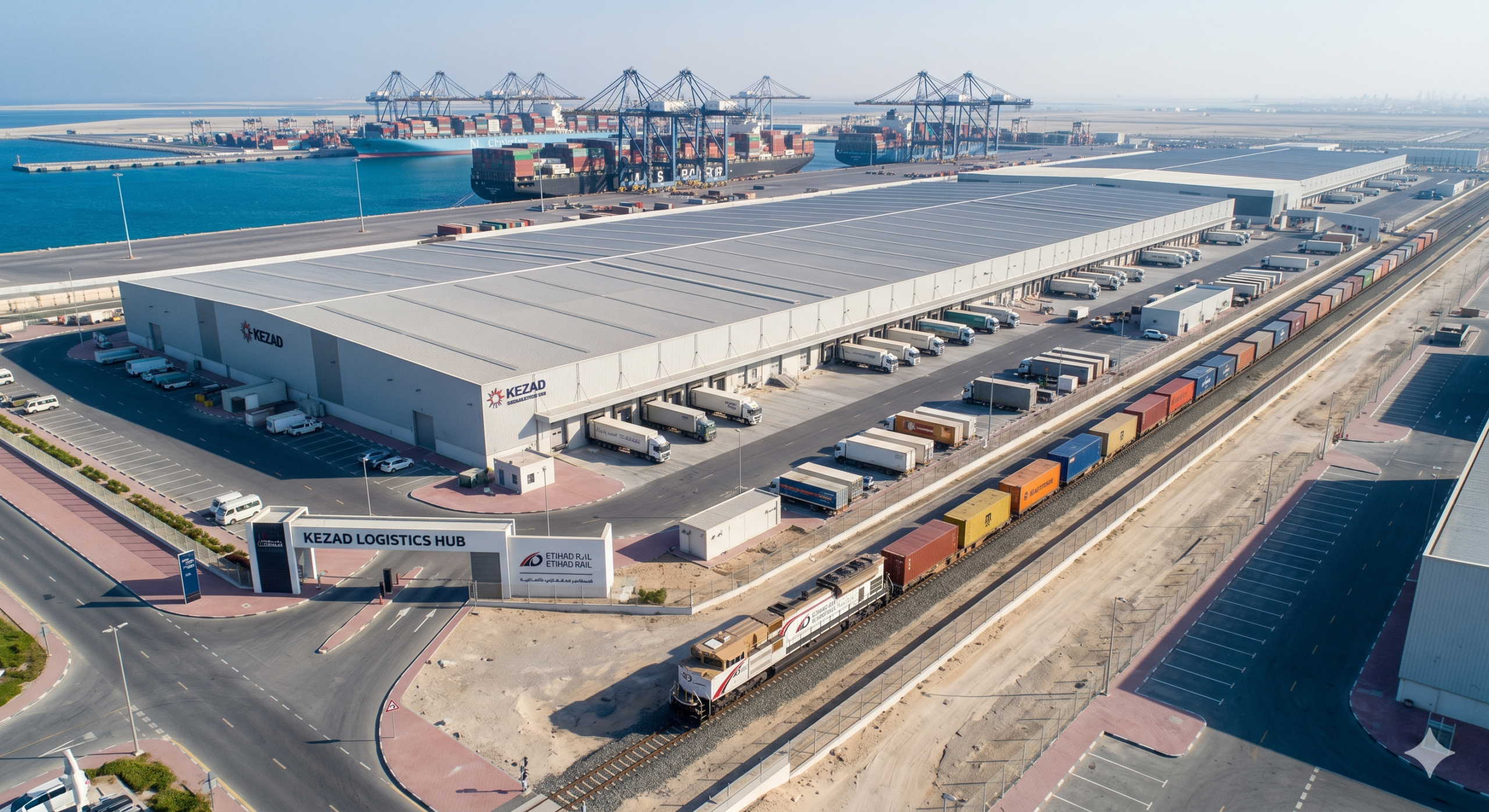
1. Khalifa Port expansion — Abu Dhabi’s deep-water port is one of the region’s most strategically positioned facilities. It handles container traffic, break-bulk cargo, and bulk commodities, and its integration with the KEZAD free zone creates a seamless port-to-warehouse supply chain that few competing locations can match.
2. Etihad Rail operationalisation — The 1,200 km national rail network is connecting all seven UAE emirates by 2030, with passenger services commencing in 2026. Freight services are already operational across key sections. Properties near rail terminals are recording value increases of 13–25%, and the effect on KEZAD-adjacent logistics infrastructure is already visible in rental data.
3. E-commerce and 3PL demand — Third-party logistics operators and e-commerce fulfilment providers are competing for available distribution space across all major Abu Dhabi industrial zones. The growth of regional e-commerce platforms and the acceleration of last-mile delivery infrastructure investment has created structural undersupply in quality warehouse stock.
Abu Dhabi’s Key Industrial Zones: A Zone-by-Zone Guide
KEZAD — Khalifa Economic Zone Abu Dhabi
KEZAD is Abu Dhabi’s flagship integrated industrial free zone, purpose-built to support manufacturing, logistics, and trade-related activities with direct port connectivity.
| Feature | Detail |
|---|---|
| Location | Adjacent to Khalifa Port, Al Taweelah |
| Zone type | Free zone |
| Port access | Direct — Khalifa Port deep-water facility |
| Rail connectivity | Etihad Rail freight access |
| Regulatory authority | KEZAD (formerly KIZAD/ZonesCorp) |
| Foreign ownership | 100% |
| Corporate tax | 0% for qualifying entities |
| Target sectors | Logistics, manufacturing, assembly, e-commerce, petrochemicals |
| Rent growth (2025) | ~38% year-on-year |
Why KEZAD? The combination of deep-water port access, free zone status, Etihad Rail connectivity, and purpose-built infrastructure makes KEZAD the UAE’s most comprehensive integrated logistics zone. The rental growth figures reflect genuine, sustained demand — not a speculative cycle.
Key considerations: KEZAD is primarily suited to businesses involved in import/export, manufacturing for re-export, or regional distribution. Businesses focused on serving the UAE mainland market will need to consider the free zone trade restriction and how this affects their distribution model.
Mussafah — Abu Dhabi’s Heavy Industry Hub
Mussafah is Abu Dhabi’s long-established heavy industrial zone, located approximately 25km south of Abu Dhabi city centre. Unlike KEZAD’s free zone status, Mussafah is a mainland industrial area, making it suitable for businesses that need to trade directly within the UAE without restrictions.
| Feature | Detail |
|---|---|
| Location | South Abu Dhabi, 25km from city centre |
| Zone type | Mainland |
| Port access | Mussafah Port (industrial and bulk cargo) |
| Target sectors | Heavy industry, oil & gas services, construction materials, manufacturing |
| Rent growth (2025) | ~27% year-on-year |
| Foreign ownership | Up to 100% (sector-dependent) |
Why Mussafah? Mussafah offers mainland status — meaning no trade restrictions for UAE domestic commerce — alongside established infrastructure for heavy industrial uses. It is the preferred location for oil and gas service companies, construction equipment operators, and heavy manufacturing.
Key considerations: Older industrial stock in Mussafah varies significantly in quality. Specification differences between plots and units are wider here than in purpose-built free zones. Careful due diligence on building condition, power supply capacity, and floor loading is essential.
ICAD — Industrial City of Abu Dhabi
ICAD (Industrial City of Abu Dhabi) is a mainland industrial zone managed by Abu Dhabi City Municipality, offering light-to-medium industrial space in a structured environment.
| Feature | Detail |
|---|---|
| Location | South Abu Dhabi (ICAD I, II, III) |
| Zone type | Mainland |
| Target sectors | Light manufacturing, food processing, logistics support, workshops |
| Rent growth (2025) | ~22% year-on-year |
ICAD’s phased structure (ICAD I, II, III) provides a range of plot and unit sizes suitable for light industrial, manufacturing, and workshop activities. It is a practical choice for businesses needing mainland status without the scale of Mussafah’s heavy industrial environment.
Abu Dhabi Airport Free Zone (ADAFZ)
ADAFZ provides industrial and logistics space with direct connectivity to Zayed International Airport, making it the natural home for air freight operators, MRO (maintenance, repair, overhaul) businesses, and time-sensitive logistics providers.
| Feature | Detail |
|---|---|
| Location | Adjacent to Zayed International Airport |
| Zone type | Free zone |
| Target sectors | Air freight, MRO, express logistics, aerospace |
| Key advantage | Airside access, fastest customs clearance in region |
What Types of Industrial Space Are Available?
Abu Dhabi’s industrial market offers a range of space typologies to match different operational requirements.
| Space Type | Typical Use | Key Specification Considerations |
|---|---|---|
| Standard warehouse | Storage, distribution | Clear height, dock levellers, floor loading |
| Cold storage | Food, pharma, e-commerce | Temperature control range, energy efficiency |
| Light industrial unit | Manufacturing, assembly, workshops | Three-phase power, mezzanine options |
| Heavy industrial plot | Large-scale manufacturing | Plot size, power capacity, drainage, access road width |
| Built-to-suit | Custom corporate requirements | Long lease terms typically 10–20 years |
What Does Industrial Space Cost in Abu Dhabi in 2026?
Rents vary significantly by zone, specification, size, and lease term. The following ranges provide a working benchmark for 2026:
| Zone / Type | Approximate Rent Range (AED/sqm/yr) |
|---|---|
| KEZAD standard warehouse | AED 350 – 450 |
| KEZAD premium logistics unit | AED 400 – 550 |
| Mussafah workshop/warehouse | AED 250 – 380 |
| ICAD light industrial | AED 200 – 350 |
| ADAFZ logistics unit | AED 420 – 600 |
Note: These are indicative ranges based on 2025–2026 market data. Actual rents vary by unit size, specification, lease term, and current availability. Contact Tate Real Estate for current market pricing.
Key Questions to Ask Before Leasing Industrial Space
Before committing to an industrial or warehouse lease in Abu Dhabi, a tenant should verify:
Power supply: What is the available power capacity in kVA? Is three-phase power available? What is the cost of connection and ongoing utility tariffs?
Floor loading: What is the rated floor loading capacity in kN/m²? This is critical for racking systems and heavy equipment.
Clear internal height: What is the clear height to the lowest obstruction (beam, lighting, sprinkler)? This determines racking height and crane viability.
Dock access: Does the unit have dock-level loading? How many doors? What is the approach road width and turning radius for articulated vehicles?
Planning and permitted use: Is the space licensed for your specific activity? Different industrial categories require different permits, particularly for food production, chemical storage, and waste handling.
Lease term flexibility: Is the landlord willing to provide a lease term that matches your operational horizon? Industrial fit-outs typically require minimum 3–5 year lease terms to justify investment.
Frequently Asked Questions
Can a foreign company lease industrial space in Abu Dhabi? Yes. In KEZAD and ADAFZ, foreign companies can operate with 100% ownership under free zone licensing. On the mainland (Mussafah, ICAD), foreign ownership up to 100% is now permitted in most industrial sectors following the 2021 ownership reforms.
Is cold storage available in Abu Dhabi’s industrial zones? Yes, though availability is limited and demand is exceptionally high. Cold storage is concentrated in KIZAD/KEZAD and select Mussafah facilities. Lead times for custom cold store development through built-to-suit arrangements are typically 12–24 months.
What is the minimum lease term for industrial space in Abu Dhabi? Minimum lease terms vary by landlord and zone. One-year terms exist for smaller units, but most quality industrial space in KEZAD and Mussafah is leased on 3–5 year terms. Purpose-built or built-to-suit arrangements typically require 10+ year terms.
Do I need a separate trade licence to operate in KEZAD? Yes. KEZAD issues its own free zone licences through the KEZAD Authority. A mainland trade licence from ADDED does not permit operation within the free zone, and vice versa.
How Tate Real Estate Can Help
Industrial property transactions in Abu Dhabi require a broker who understands specification requirements, zone regulations, and the current availability landscape — not just one who can forward a listing. Tate Real Estate advises industrial occupiers and investors across KEZAD, Mussafah, ICAD, and ADAFZ, from initial requirement scoping through lease negotiation and registration.
Contact Tate Real Estate to discuss your industrial or warehouse requirements in Abu Dhabi.

